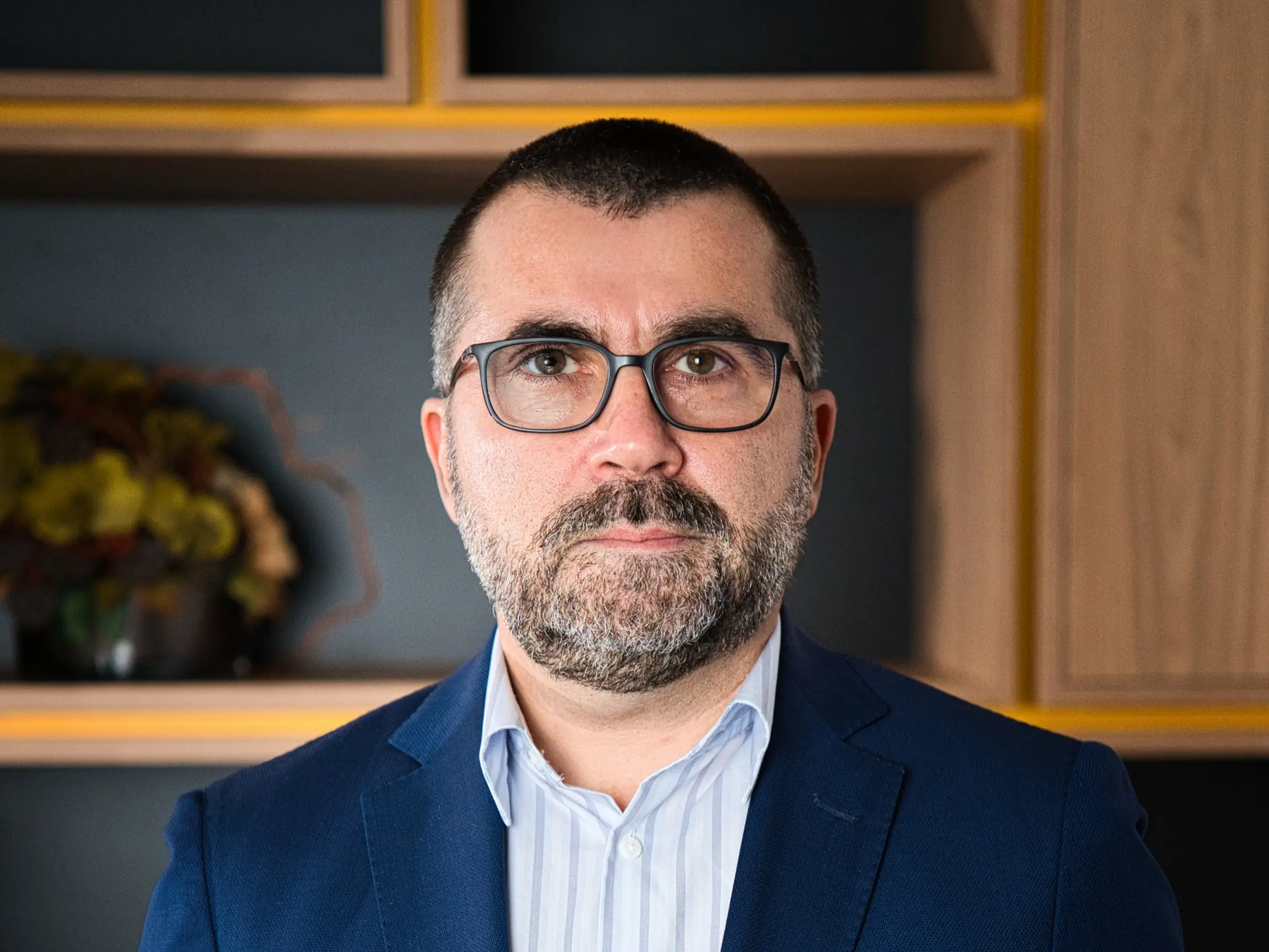
Ömer Tetik, CEO of BT: In recent years, our bank has strengthened its role as a leading financier of strategic projects at national level

Ömer TetikCEO of Banca Transilvania, analyzed for Ziarul Financiar the current economic context in Romania, the essential role of banks in the economic recovery and trends in the mortgage market. The full interview can be read below:
1. How can the economy recover now, when all the engines that have sustained the economy over the last decade are falling?
We are at an important moment for the Romanian economy, when the classic drivers such as consumption, lending, real estate and public investment, which are reflected in general welfare, supported by wage growth in the public and private sectors, can no longer sustain growth on their own.
Economic recovery requires strategic reconfiguration, regional expansion thinking of local companies, a focus on investments in energy and infrastructure, innovation, digitalization and de-bureaucratization, balanced tax reforms, programs to support exporters and entrepreneurs.
The coming year will certainly be a test for the Romanian economy, but also for social cohesion, where we also have consistent fractures, and the current austerity will worsen further the polarization of the population and social cohesion problems.
Here I would like to emphasize one absolutely essential point: Romania must fight and be a competitive destination for foreign and local investment. We need to attract capital and investment, otherwise we cannot relaunch the economy. In order to attract investment, we need to be competitive because there is competition for investment between countries and even between cities in the same region. Capital is available in the world, but capital and investments go where they are well received, where they find a friendly environment, clear legislation, lack of red tape and friendly taxation.
Romania must be a competitive destination in all these areas. This is the only way to attract investment, and investment brings renewed economic growth, jobs and prosperity.
We also have reasons for optimism. The current challenge comes at a time when we have elements that help us, elements that we have never had in the history of the country. Prosperity has increased a lot in recent years, even if we don't always recognize it, and we want more. We also have a substantial "stock" of accumulated savings and Romanian entrepreneurs are much more sophisticated than in the past. At the same time, the solidity and strength of the banking sector is an anchor, given the very good indicators that banks in few countries in Europe have. All this can be a springboard for recovery.
2. How can private investments be revitalized, from Romanian to foreign investments?
Romania continues to be an attractive destination for investment, benefiting from a number of unique advantages, from the cost of labor and the level of education in our country, to its geographical location - more recently supported by increased investment in infrastructure and Schengen accession - to the potential domestic demand for products and services (demand that is significantly higher than supply).
At the same time, the return on investment in Romania is still good, although here we have to bear in mind that the deterioration of the tax regime may be a factor that delays or 'scares off' certain investments.
However, we can count on the country's strategic advantages, such as the fact that Romania is today one of the safest destinations in Europe. NATO membership reinforces this security, offering investors additional guarantees on regional security and critical infrastructure protection.
Another factor with an immediate impact on investment growth are government guarantee programs, which have an accelerating effect and are a multiplier, as it is rare to reach the State guarantee. Basically, for the State, the return on these programs is very good. They generate economic growth, investment and jobs, and all of that comes back in taxes collected by the State. Therefore, in this case, the default rate is low. That's why these programs are more of a spark to restart the economy, and now is the time when we need them.
3. How can banks contribute more to economic recovery?
Banks are an essential ally for the authorities in supporting Romania's economic growth and development. The Romanian banking system plays a central role in financing companies, whether they are private or state-owned, small or large players, Romanian or multinational companies present in Romania. Economic recovery depends on investment, and banks can accelerate this process by co-financing investment projects and by developing efficient solutions for smoothing and optimizing commercial credit.
The primary role of banks is to finance the economy, businesses and consumption. This must continue to happen and we need to find ways - together with the authorities - to increase financial intermediation and funding. Then, another important role can come from co-financing public projects and European funds. Both have been a driving force for Romania in recent years and this must continue and accelerate.
However, banks must remain efficient and profitable so that they remain an agile player and a competitive advantage for the country's economy. Our goal is to preserve and build a sector that is as efficient as possible, able to finance the population and the economy at the lowest possible operating costs.
Personally, I am constantly looking at additional alternatives to streamline and expand funding, given that all banks in the European Union operate in a highly regulated framework with very strict funding conditions. It is essential to have government guarantee programs, funds and banks - state and trans-national - to provide guarantees or co-guarantees. This is an important subject because we work with clients' money and we have very strict regulations, which is why we cannot lend everything we want and as much as we want. Co-guarantee programs are vital in order to be able to finance sectors, areas or projects that we would otherwise not be able to finance because of restrictions imposed by financial indicators or the regulatory framework.
4. At the moment is corporate lending being held back by difficult market conditions - high interest rates, increased bank risk-taking - or by a lack of demand for loans from companies?
In general, I can tell you that businesses know how to adapt to different market conditions. What is harder for businesses is to adapt to uncertainty and unpredictability. Hard to say which factors weigh more. We have had higher interest rates for a few years now, yet lending activity has been brisk. This year other factors have come into play, and perhaps the general level of optimism, which is very necessary for investment decisions, is lower.
In the first half of the year, we saw a positive evolution of loans, even though the state-guaranteed programs such as IMM Invest did not continue this year.
The balance is growing and our estimate for average annual growth is around 6%. Growth is there, but obviously the growth is lower, and in this context dynamics are important to generate economic growth.
The challenge we face is that this pace is not enough to close the large gap Romania has with the West and even with the region in terms of banking assets as a share of GDP (where we are last in the region and far behind Western Europe).
I think the main factor now holding back growth is lower demand for credit as investment is delayed. There is also the absence of government guarantee programs, which is usually a catalyst and generates demand - customers make plans, even if they then finance them with other sources or with a classic loan.
5. How much does Banca Transilvania now support lending in foreign currency, where interest rates are lower, as an alternative to lending in lei, where interest rates are higher?
We offer foreign currency credit and have products - for both corporate and retail customers.
In the case of companies, the discussion is relatively simpler, because we are talking about clients with complex banking needs, who have treasury or hedging strategies. They also operate across borders and foreign currency lending suits them and does not expose them to currency risk. In the case of individuals, foreign currency loans are intended and recommended only for customers earning income in foreign currency, so the market is much more limited. The products exist, but addressability needs to be assessed on an individual basis.
6. How can a bank outperform the economy in which it operates?
The Romanian banking sector is among the most solid, well capitalized and efficient in Europe. It is also a very competitive economic segment, with a large number of competitors competing on prices and offers for customers. In addition, banking is an area where economies of scale matter a lot and small banks find it difficult to be profitable, especially if they are not specialized.
On the other hand, and most importantly, if we look at all the capital that a bank's shareholders make available to a bank to operate, we see that the return on this capital is similar to other industries and certainly banking as a whole is somewhere in the middle of the profitability ranking.
In short, even if the nominal returns we are looking at for some banks are high, they are high because these banks use a lot of shareholder capital and the returns are rather normal.
Another factor that we expect to contribute positively to the bank's results is that financial intermediation in Romania is low and financial inclusion will increase. We are one of the countries in the region with the lowest share of banking assets in GDP, but also with the lowest banking assets per capita (less than half compared to Poland, for example). This means that the banking sector has great potential, and within the banking sector we have already demonstrated a long track record of above market average growth.
7. What problems are Romanian companies facing?
One of the major structural challenges faced by Romanian companies is the insufficient level of capitalization, both in terms of retention and reinvestment of capital in the business and access to sources of capital.
Modest capitalization limits not only access to finance, but also the ability of firms to implement their plans for re-engineering or investments that generate higher economic value, which gives them a competitive advantage as well as a faster adaptation to certain market fluctuations.
However, in recent times we are seeing more and more successful examples where companies manage to strengthen their capital either by accessing the capital market, listing on the stock exchange, or by partnering with private equity funds. These examples show that the Romanian business environment is evolving, finding solutions for financing and sustainable development. Obviously, there are other challenges as well, but if we look at the dynamics, we can see that the business environment in Romania, and the country as a whole, has evolved a lot and many of the difficulties we faced in the past have been resolved.
8. Which economic sectors does Banca Transilvania finance more?
We aim to provide financing solutions for all economic sectors, while respecting the principles of concentration established strategically for each area. Historically, Banca Transilvania has focused on sectors with a significant impact on GDP, such as agribusiness, medical or trade - for which we have created competence centers at BT.
In recent years, our bank has strengthened its role as a leading financier of strategic projects at the national level, from major infrastructure development to supporting investments in regional hospitals and energy projects.
Energy is a new entry among the priority sectors for BT due to its strategic importance in terms of business (financing potential), the economy (competitiveness in the region) and national energy security.
9. How is the financing of large companies, large vouchers, a segment in which Banca Transilvania wanted to expand more?
We continue our strategy of being the main financier of strategic projects in Romania. This year, the bank was either a direct financier or arranger of syndicated loans for major projects in infrastructure, energy - production and transport - as well as renewable energy.
The dynamics in the large corporate segment - both local and multinational - are steadily growing and we are steadily gaining market share. In parallel, we are maintaining our strategic focus on product development, created in partnership with these companies, to facilitate trade credit liquidity and to support the development of the ecosystem of SMEs that are customers or suppliers of large companies.
We will continue to grow and focus on this segment. We have built a good team, we have the necessary skills and the size of the bank allows us to be competitive with any type of customer, including very large firms.
10. How is going the SME and micro segment where the bank is the main banking player?
The small and medium-sized business segment is strongly influenced by the level of confidence in the future, in prospects. We are going through a tense period, marked by stress and where many messages about crisis and uncertainty prevail in the public space. I think it is essential to keep a balance between messages about austerity and messages that inspire confidence in our potential as a country, as an economy. We see sustained activity in the SME business line, with the necessary adjustments and adaptations to the current context. Entrepreneurs look forward to the launch of new government programs to support the business environment. At BT, we continue to be confident, building on the solid entrepreneurial experience we have accumulated over the years, as well as on the capacity of the business environment to reinvent itself and be resilient.
11. Why are banks focusing more and more on selling investment products to customers?
Because they want banks, but they also want customers. I really think the trend has actually started with customers, not necessarily banks. I've noticed that in the last few years - more accentuated in the last 3-4 years, with the post-pandemic period and the start of the war - customers are looking for yield. In particular, middle-income and above-middle-income customers in large urban areas are looking at products that might yield higher returns. It's a global trend, with the retail market looking much more closely at equities, ETFs and mutual funds, as well as bonds and other products. Romania has aligned itself with this trend and clients are looking to participate much more actively in the financial market.
We have also seen people taking risks that we believe are disproportionate and can cause problems: people opening trading accounts on international platforms in unregulated jurisdictions or exotic countries, or buying products that they do not understand or have insufficient time to study - particularly equities, derivatives or ETFs. These all involve risks for clients and we do not recommend them.
For this reason, in line with the trend launched by retail customers, we have launched standardized products, very good, regulated in Romania and much safer, which offer customers the chance to participate in the stock exchange and in the financial market, but in safe conditions.
We want to grow here. We have good products, but other, more diversified products will come. The potential is enormous. Just think, in less than a year, almost 150,000 investors have chosen BT Pay for BT Asset Management investments.
12. How much longer can Banca Transilvania support the financing of the state budget by purchasing government securities? Isn't the exposure already too high?
When we look at a bank's exposure to government securities we need to consider a number of factors beyond the size of the exposure itself or the percentage of exposure to total assets. We look at factors such as the average duration to maturity of the portfolio, the current yield of the securities, or the potential for the securities to rise or fall. If we take all these factors into account, I think we are at an optimal level.
The yield on our securities portfolio is high - unfortunately, this means that the State is borrowing at a high price. This yield reflects objective factors, but also subjective factors, such as the lack of depth and sophistication of the Romanian financial market. I think this points to inefficiency, which is good for us, because we are getting a very good return on our securities portfolio.
13. How was the OTP integration process closed? What did Banca Transilvania gain from this acquisition?
The integration went according to plan and we completed it in March this year. We were able to complete the integration in record time, in just seven months, running in parallel with another integration and merger, that between Victoriabank and BCR Chisinau in the Republic of Moldova. The implementation went very well. The similarities and synergies between BT and OTP Bank Romania, as well as the involvement of the teams from the two banks, have been enormously important and part of the success.
BT has strengthened its market leadership position to around 23%, both through the integration of OTP Bank Romania and its organic growth. The merger has brought +9% assets, +13% loan portfolio, larger presence in Bucharest and in the center of the country, as well as the Hungarian Desk approach for customers in certain areas of the country.
It also helps us on the profitability side because BT has a lower cost of funds than OTP and so we are better capitalizing on the loan portfolio we have taken over. At the same time, we have a more diversified product range and so we are able to offer customers more products - with a positive impact for both customers and the bank.
14. How can BT grow more on the leasing side of the capital markets?
BT Leasing will grow by consolidating synergies within the Banca Transilvania Group and by diversifying leasing products thanks to the partnerships we have with car dealers and equipment suppliers. We plan to introduce mobility solutions, such as monthly subscriptions or operational leasing, but also other financing solutions to ensure a permanent renewal of customer technologies for greater efficiency. Digitalization of products and processes is another strategic direction and an online leasing product will be launched next year.
BT Leasing has experienced accelerated growth in recent years, primarily due to the BT Group's M&A strategy, whereby it integrated three leasing portfolios. As a result of these acquisitions, but also through the organic growth of the business, we have almost 42,000 customers and the balance of leasing assets reached RON 6.3 billion, 26% higher than in the same period last year, while the leasing market grew by about 12%. We are growing significantly above the market average and we want to maintain this pace.
BT Capital Partners is the largest broker in Romania with 28% market share across all segments. It is also one of the most active brokers on the BVB in recent years in terms of offerings on local and international markets. The volatility registered in the first part of this year and the recurring issues, as well as the progress in terms of operations and trading platform, all contributed to the significant increase in volumes and number of clients.
With volumes up around 13% on average daily volumes in 2025 compared to last year across all market segments, BT Capital Partners is up around 38% at end-September 2025 compared to the same period in 2024.
The capital market remains a strategic direction for us - it is a "product" in demand by clients and appetite in the market is very good. On the other hand, it is also extremely important for Romania to increase the depth of the capital market and the sophistication of products. It is an area that needs to grow because it brings wealth, increases the capital available in the market for investment in firms and is directly correlated with the asset management and pensions market. Our role - as the country's largest financial group - is to contribute to the development of this market, which is crucial for the country's future.
15. At what stage is the acquisition of BRD Pensii and what will BT gain from this transaction?
We are in the process of obtaining authorizations from the Financial Supervisory Authority for BRD Pensii. Once the acquisition is finalized, BT will expand its private pension business in the Pillar 2 segment, managing more than RON 8 billion on behalf of more than 600,000 participants in the BRD Pensii privately managed pension fund.
We are confident in the potential of the local capital market and are constantly investing in the development of our pension, asset management and brokerage teams to ensure the well-being of our clients. In any strong, developed economy, these pillars are essential, helping to boost returns and improve people's financial prospects for both current and long-term needs.
16. How is mortgage lending doing as real estate transactions slow down?
Despite the challenging economic context, we are maintaining our position as the main financier of the residential market in Romania. In a period of increased volatility, driven by rising inflation, a new tax regime, and a freeze on public sector salaries, our response is a balanced lending policy and predictable financing solutions, so that we remain a good option for our clients.
Real estate transactions are down compared to last year and I think this is to be expected, given the public and political discourse, the economic reality and the strong dynamics of previous years. However, we have managed to slightly increase new financing and also to increase our market share in the segment. However, the market is extremely active in the area of refinancing - banks are looking for customers and I could even say we are seeing a price war, an interest war.
On the other hand, here we have a paradox - despite the high yields on government bonds and interest rates in the interbank market - the real estate credit market is extremely competitive and we see very low interest rates.
If we look at the US or other developed countries, we see that interest rates on real estate loans are significantly above the yield on 10-year government bonds. And we see that current interest rates are significantly above the interest rates charged by banks 4-6 years ago. In Romania it is the reverse. Mortgage interest rates are well below the interest rates on 10-year government securities. What's more, although the general level of interest rates has risen in recent years, interest rates on real estate are holding steady or falling.
The mortgage financing market is very competitive and interest rates are favorable to customers, who can borrow at good prices.
17. What is the impact of the doubling of the bank levy on the bank's result?
The doubling of the bank levy represents an impact of around 500 million lei for Banca Transilvania. As a comparison, in 2024 BT's contribution amounted to around RON 270 million. Even under these conditions, analyzing the bank's performance so far, the increase in the levy does not change our plans, the commitments undertaken to achieve the budgeted targets in 2025. In other words, we are staying the course and courageously moving forward.
It is not a pleasant situation and we insist that this must be a temporary solution because it affects the competitiveness and efficiency of a critical sector, which then ripples through the economy. But we understand the complicated budget situation and we stand in solidarity with the country.
18. When will lei interest rates fall?
Personally, I have complete confidence in the NBR's monetary policy decisions. The central bank has a very good track record on both the Romanian economy and monetary policy decisions. Unfortunately, we have very high inflation, which is caused by structural issues, such as the supply/demand deficit, as well as by the recent increase in VAT and other taxes and the removal of the energy price cap. The increase in VAT and the removal of the cap are one-off events that do not lead to a recurrence of higher inflation. But the supply deficit is problematic and can only be solved in the long term with investment and European funds.
On the other hand, the high interest rates in Romania are also caused by the very high yields that investors demand to buy Romanian government bonds. This is another problem and things are correlated. We hope that as early as this autumn the government will see the budget deficit stabilize and then move quickly to stimulate the economy. However, I don't think we will see interest rates lowered aggressively in the near future. Maybe only mild cuts, and not immediately, as they are cut further across the pond and in the rest of the world.
19. Which economic sector has performed above expectations this year?
We all know that the bad news for Romania is that we spend far too much - as a country, as people. The good news is that in recent years Romania has also recovered in terms of public investment in both infrastructure and construction. Similarly, these sectors have also been boosted by European funds of all kinds, and this has generated a ripple effect in other industries too. I could also say that we also have some sectors that have been influenced by our entry into the Schengen area - such as transportation.
For agriculture, 2025 was a better year after several years of poor performance. Moreover, we also saw a revival in the livestock sector, which had also suffered in recent years.
20. What is the impact of the difficult market conditions - inflation, high interest rates, economic stagnation, falling consumption - on the bank's activity?
We do not see a direct impact so far, but rather side effects. NPLs are under control and we do not have an increased cost of risk. Credit appetite and bank products are the same, within normal limits. We are not seeing the same increases as in the past, but they are within normal limits.
One effect that we are already seeing is that as people, our customers are earning less money or the same money, but, affected by inflation, they are consuming less and transactions are not growing at the same pace. This is a first effect that we are seeing, but it is more of a secondary effect, not a direct effect in the relationship with the bank.
It is a difficult time for many clients, but Romania has a very good potential and I believe that with the introduction of economic stimulus measures, which we hope will come soon, the trend will gradually reverse and optimism will return to the market. It is also important that there are no internal or external shocks - political, macroeconomic or crisis, but also that at the end of the year we have a period of fiscal calm, where companies are not surprised by tax or legislative changes.